A Thesis · v2.0 · June 2026
The future of AI, and the design industry.
AI is making software almost instant to build — so the value is racing toward the one thing that stays hard: running it safely.
For a long time, the moat — the durable edge rivals can’t easily copy — was simply being able to build the thing. AI is erasing that. It can now turn out working software, content and answers on demand, so the advantages products used to charge for are becoming free and everywhere. The market is compressing.
When output is nearly free, the value moves to whatever is still genuinely hard — and the hardest problem left is trust: letting AI act on its own inside a real business, with real data, customers and money at stake, without it going wrong.
That takes serious plumbing: systems that run whole fleets of AI “agents” — software that acts on its own instead of just answering questions — with oversight, permissions and guardrails. It’s complex and unglamorous, which is exactly why it’s the new moat. This thesis is about that shift, and what it means for products, the companies building them, and the designers whose craft is about to change.
01
The great compression
Every AI product sits somewhere on a spectrum of autonomy. At one end, a person does the work and AI assists. At the other, the system runs itself and the person governs. Where a product sits now decides how much room it has to grow.
General-purpose models — Claude, ChatGPT, Gemini and their peers — keep getting better at the low-autonomy end. Anything that is “assist me” or “draft this for me” is being commoditised, handed out for free by the labs. As they expand, they compress the moat beneath every AI product built on those same capabilities — and the defensible market gets squeezed up to L3–L4: products that act on their own, safely, at scale.
L1 Assisted — you drive, AI suggests. L2 Copilot — AI drafts, you approve. L3 Autopilot — the agent acts on its own, humans manage by exception. L4 Self-Driving — you give a goal; the system runs its own experiments and improves.
As the big models expand, they compress the moat beneath them — and where you sit decides how much room you’ve got to build.
02
The new moat
The products that last won’t do it with a nicer chat box. They’ll do it with governance — being able to run fleets of agents safely. That is the capability the labs can’t commoditise, because it lives in a company’s own rules, data and risk tolerance.
Think of the gap between letting a new hire draft an email and letting them move money out of the company account unsupervised. Governance is everything that makes the second one safe to allow — the permissions, the checks, the audit trail. That’s the hard part, and it’s where the value now sits.
Two things define that defensible end of the market:
The moat isn’t the model. It’s the governance layer wrapped around it.
03
Agent infrastructure design challenges
That’s the shift at the industry level. Here’s where it lands for the people who design and build — and it starts with a whole new surface to get right.
Governance, version control, monitoring, approval loops — none of these are new. But autonomous agents will need far more sophisticated versions of them: systems that can supervise thousands of actions safely, at scale. That depth is almost a new product specialty in itself — and it opens fresh ground for product designers. You don’t own all of it; you own a slice, and you own it deeply. Each of these is a real design problem waiting for someone who understands both the craft and the machinery.
Monitoring
real-time visibility into every agent's activity, performance and cost
Roles & access
control who on the team — and which agents — can build, edit and deploy
Data residency
keep an agent's data inside the region it's allowed to run in
Version control
full history on every agent — roll back to any previous state
Audit logs
every action, decision and tool call — logged and exportable
Human-in-the-loop
approval gates on risky actions; agents escalate when they're unsure
SSO / SAML
enterprise sign-on, so identity and access live in one place
PII masking
redact personal data before it ever reaches the model
Observability
export telemetry so you can see what the whole fleet is doing
Every one of these is a design job that barely existed two years ago.
04
Designers need to become AI-fluent
To design for AI products, you have to understand the tech underneath. Not to write the model — to know what it can and can’t do, where it breaks, and what the moving parts are called. Here is the vocabulary every AI-native designer should be able to hold.
LLMs
the model that reads and writes language. Everything else wraps around it.
Context
what you put in the window. The model only knows what's in there.
RAG
fetch the relevant docs, feed them in as context, then answer.
MCPs
a standard plug for connecting tools and data to a model.
APIs
how software talks to software. Agents call them to act.
Tools
functions an agent can call to do things, not just talk.
Triggers
events that start an agent without a human asking.
Multi-agent
many agents split a job and coordinate on it.
Concurrency
agents running in parallel instead of one at a time.
You don’t need to build the models — but you do need to know what they can and can’t do.
05
The triad blurs
The walls between Product, Engineering and Design are thinning. With AI translating between them, a designer can draw on far more context — the product strategy, the codebase, the systems around a feature — and weigh in with real substance across all three. You don’t become a PM or an engineer; you make better design decisions, faster and with more confidence — and you can step in to fill a gap when the team needs it.
The reach runs across the process too, not just the roles. With more context, a designer can weigh in further along the whole arc — scope, UX, UI, and the code underneath.
I believe this because I’ve lived it — four teams, fourteen months, one role that kept flexing to cover whatever the team was missing.
Filling whatever gap the team needed taught me to use AI to upskill fast — and made me a better designer.
Every team will have an AI OS
Fluency compounds into something bigger: every IC ends up running their own operating system — a personal stack of connected tools and automations that makes AI feel native to their work. Context is king, and whoever wires theirs up best gets the most out of AI.
Soon everyone brings their own wired-up system to work; the best-connected context wins.
06
Code becomes the canvas
Every designer will talk with the codebase — scoping, brainstorming and prototyping grounded in the real product instead of a static mock. You connect your stack over MCP, ask how things actually work, and design against real constraints.
And it doesn’t stop at code. Models read the world through text — so the plain file becomes the interface to everything. A Notion spec, a call transcript, a Figma flow, a PostHog metric: flatten each one into markdown and they stop being scattered documents in ten different tools and start being a single database your agents can query.
That’s where the leverage moves — to whoever curates their context best. The designer who keeps a searchable second brain (decisions, research, guardrails, all in files) hands every agent the same grounding a senior teammate would have. Context stops being something you have and becomes something you ship: the better-organised your files, the sharper everything built on top of them.
The mockup stops being the deliverable — the living product takes its place.
07
Lighter hand-offs
AI smooths the hand-offs between specialists. A designer can carry an idea further — turning scattered context into a clear, well-scoped brief — so engineering starts from something sharp instead of a vague mock. The work still flows to the right people; there’s just less lost in translation.
And when engineering is stretched, a designer with this fluency can pick up a small, well-scoped change to unblock the team — filling the gap instead of waiting on the queue.
None of this is theory. It comes from doing the work — embedding as a designer inside an AI startup, in the codebase, shipping on an AI product like an engineer. These insights come from pushing past where the design role usually stops: a year of my own contributions across the RelevanceAI repos.
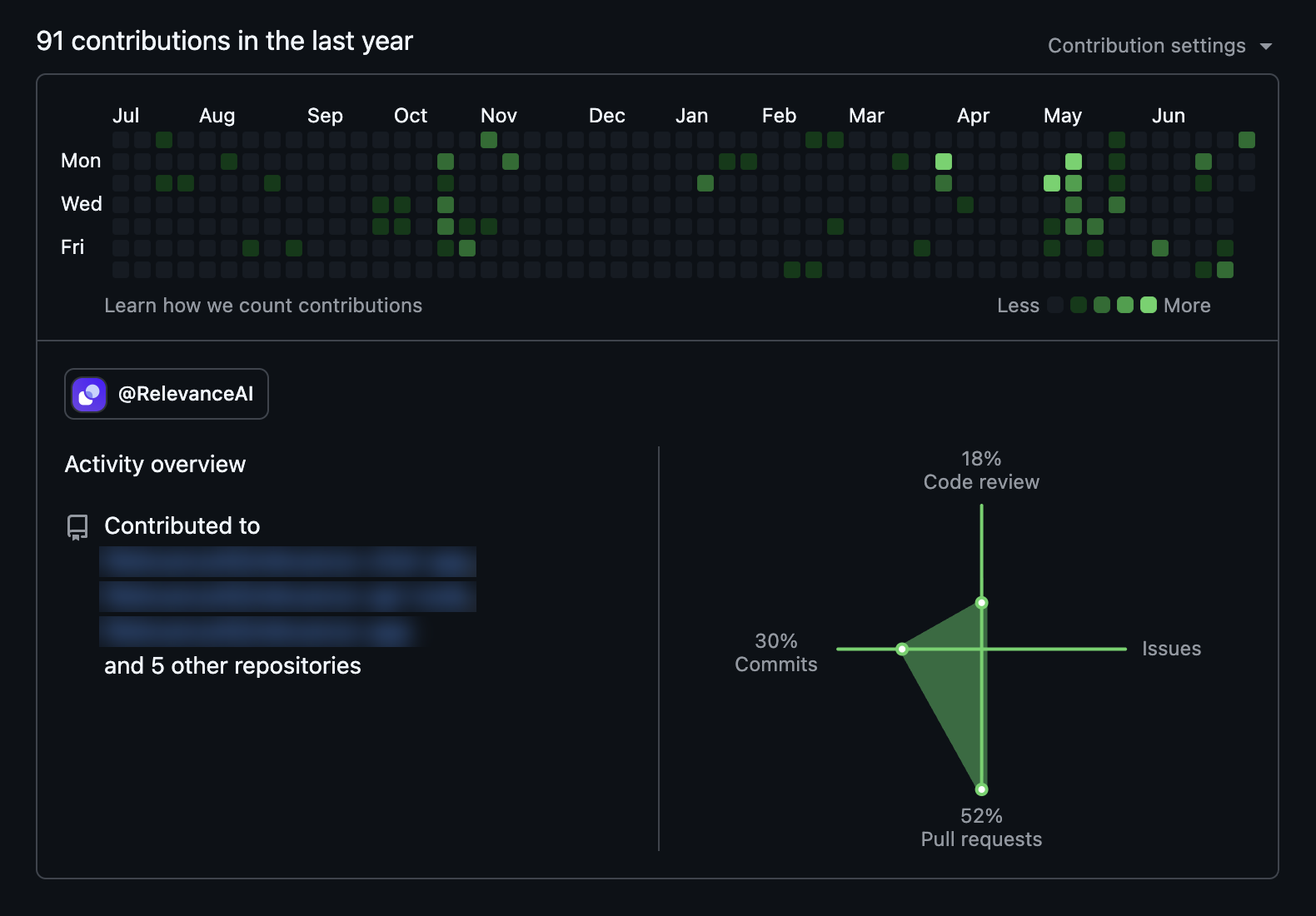
Less is lost in translation, and a designer can carry an idea most of the way there.
08
Where I come in
I don’t want to watch this shift from the sidelines — I want to help shape it. This is one of the biggest changes our field has faced, and how we move through it matters as much as where we land.
My work is helping designers and teams navigate it with clarity instead of fear — and come out more capable than before.
The role is expanding. I want to help our field make that shift with confidence — and bring as many people with me as I can.
// FROM A RECENT LIVE WORKSHOP WITH DESIGNERS AND PMs